
AI agent instead of a chatbot: how to stop wasting budget and losing clients
Your chatbot still works like a form? In 2025 that kills sales. A guide to launching an AI SDR that qualifies leads 24/7 and books meetings.
AI agent instead of a chatbot: how to stop wasting budget and losing clients
Problem: is your site a “leaky bucket”?
Let’s be honest: B2B marketing in 2025 isn’t about pumping traffic. It’s about not losing those who already arrived.
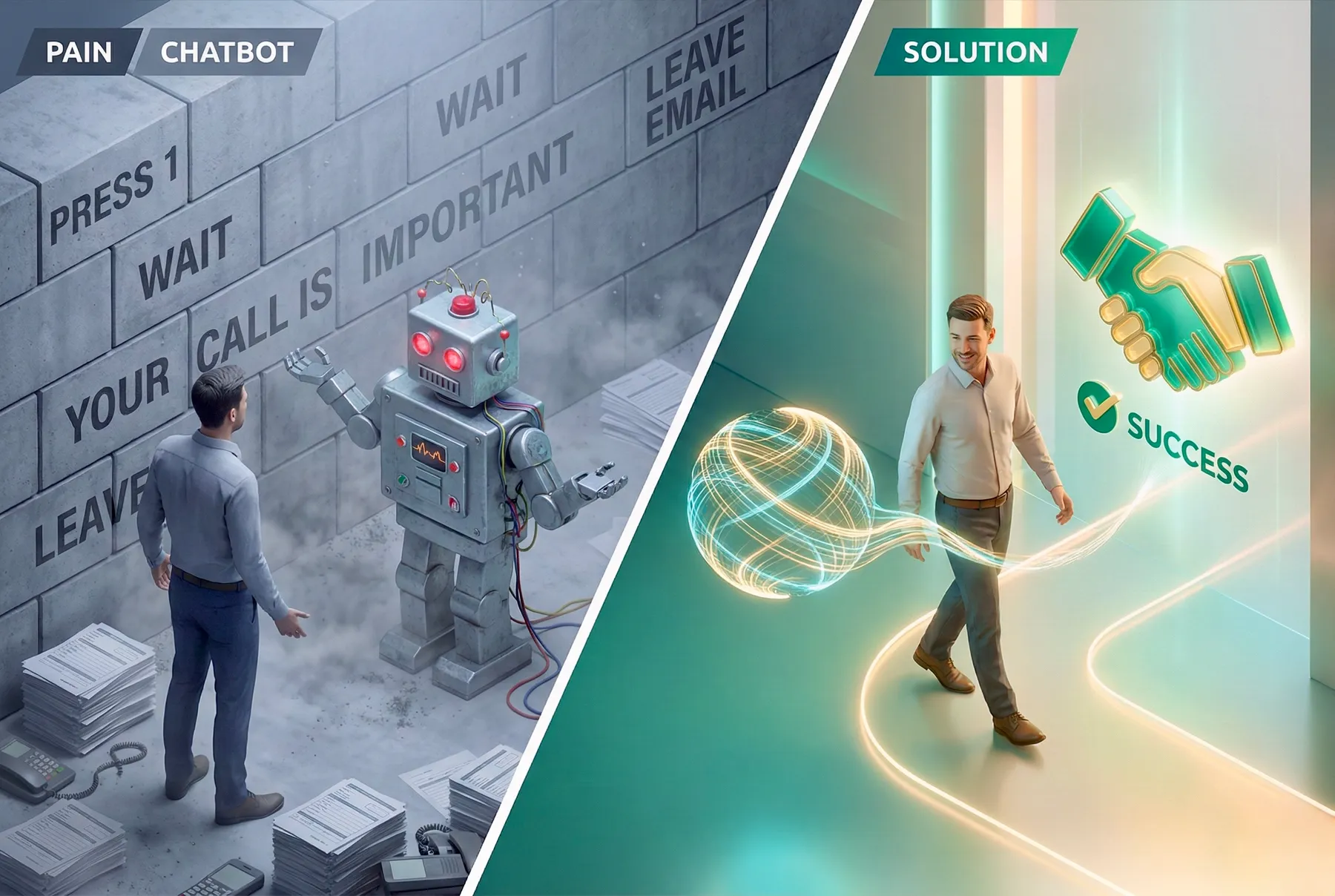
Imagine a customer. They click an ad (you paid for it!), want pricing or a case study, open the chat… and see THIS:
“Hi! Leave your email, phone, grandma’s name, and blood type — we’ll call you someday.”
What does the customer do? Close the site. In the dopamine economy, slow service burns cash. If you don’t answer in 3 seconds, or you start interrogating instead of helping, you lose.
Why legacy chatbots irritate people:
- Scripted interrogation. “Who are you? What’s your budget?” — the bot demands data before it gives value.
- Tone-deaf. User is on “Pricing,” the bot offers “About us.”
- Ignore mode. “Operator will reply within 24 hours.” Seriously?
Marketing cries that leads are expensive, sales complains they’re “cold.”
Agitation: the price of a “dumb” bot is real money
Every missed dialog is a hole in the budget. An old button-bot is just a feedback form in a robot mask. It doesn’t qualify, doesn’t sell, doesn’t help.
Competitors who already deployed AI agents steal your clients because they answer instantly.
- 50% of deals go to the one who replies first with substance.
- An AI agent captures attention and drives the deal cheaper than a human rep.
You don’t need a “widget”; you need a digital employee.
Solution: AI agent as your best SDR
Meet the AI agent (AI SDR). It’s not a script. It’s a neural model trained on your data. We build agents integrated into the business core that:
- Run on RAG. They know everything about your product, rely only on your docs, never hallucinate.
- Speak human. You talk as with a person, not by pressing buttons.
- Are CRM-native. They create the deal, log history, and call a human only when the lead is ready to buy.
Three paths — pick your scenario
Don’t buy a tool for the sake of a tool. Choose the model that fits you.
1. “Deal Hunter” (Drift)
Ideal for: Complex B2B sales where every big client matters.
How it works: Goal is not chatting — it’s selling the meeting. The agent spots an ICP fast and immediately offers free slots in the manager’s calendar.
- Result: Calendar full of meetings, not empty conversations.
2. “Caring Assistant” (Intercom)
Ideal for: Online services, schools, support.
How it works: Goal is to offload people. The agent handles 60% of routine: answers FAQs, sends guides, solves issues itself.
- Result: Customers get instant help, your staff doesn’t burn out on repeat questions.
3. “Best Friend” (HubSpot AI)
Ideal for: Teams living in CRM.
How it works: The agent remembers everything. If the customer viewed Pricing yesterday, it says: “Hey John! Back to plans? Want the yearly discount breakdown?”
- Result: Customer feels known and valued.
5 steps to the ideal AI agent (guide)
How to make the bot sell, not annoy?
Step 1. Personality (Role)
Forget “Bot Alex.” Call it “Support Assistant” or “AI Consultant.”
- Tone: Lively, pro, no bureaucratese.
- Language: Emojis and short phrases allowed. It should sound like your best rep in a good mood.
Step 2. Smart hook
Bad: “How can I help?” (boring). Good: “I see you’re on Enterprise pricing. Want to save 20% on yearly?”
Use page context. Offer value (ROI calculator, case), not “contact us.”
Step 3. Qualification without interrogation
The agent should talk like a seasoned salesperson. Instead of “Your budget?” ask: “To suggest a relevant case, tell me your current team setup.” Feel the difference? It’s care, not a questionnaire.
Step 4. Handling objections
Write scripts for “Too expensive” or “I’m just browsing.”
- “Too expensive.” Show value and ROI, don’t go silent.
- “Just browsing.” “Cool, I’ll send you a quick guide so browsing is useful. Where to send?”
Step 5. Training loop
An AI agent isn’t perfect out of the box. Once a week, review dialog logs.
- Where did the customer drop?
- Which answer was off? Keep tuning the knowledge base. That’s your capital.
Case: numbers
What happens when you swap the “dumb” bot for an AI SDR?
- x2 conversion. From random visitor to SQL.
- Savings. Agent takes 30–60% of first-line load. No bloated headcount.
- Speed. Customer gets a reply in 0.3s. Trust builds instantly.
What to do right now
Don’t take my word for it. Check yourself.
- Open your site on mobile.
- Ask your chat something.
- If you wait or fill a form — you’re losing money right now.
Want an AI agent that really sells, not just hangs on the site? Send a request. We’ll show a demo on your data and build a prototype in 1 week.